In math, the y-intercept is y-coordinate of the point in which a given function or graph crosses the y-axis. Remember it by thinking “y-intercept is how far up it intersects the y-axis. Just in case you forgot, the y-axis is the axis that goes straight up, and the x-axis is the horizontal one.
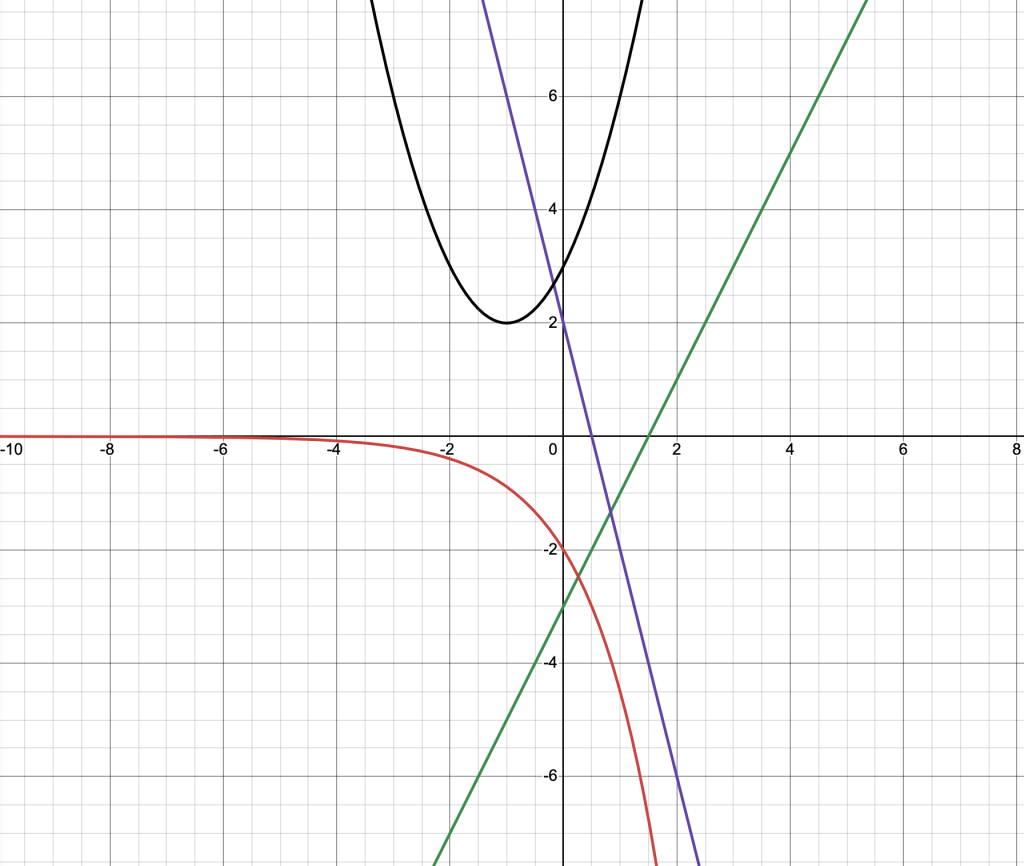
The purple line’s y-intercept is 2.
The green line’s y-intercept is -3.
The red curve’s y-intercept is -2.
The black curve’s y-intercept is 3.
The y-intercept’s symbol is usually “b”. For example, in the slope-intercept form of a line equation, “b” is the y-intercept. Slope intercept form is y=mx+b, with “m” being the slope.
For basically all normal functions, if there is some “+6” or “-2” (but not a times or divided) or something like that without an x (or y) attached at the end of a function, it is probably going to be the y-intercept. For example, let’s take the cube root of x squared divided by 3, all plus two. In math, this would be:
cbrt(x2)/ 3+2
We can add a “y =” before it, leading to:
y = cbrt(x2)/3+2
In this, just ignore everything except the “+2”. This makes the y-intercept 2!
Let’s see if I’m correct.
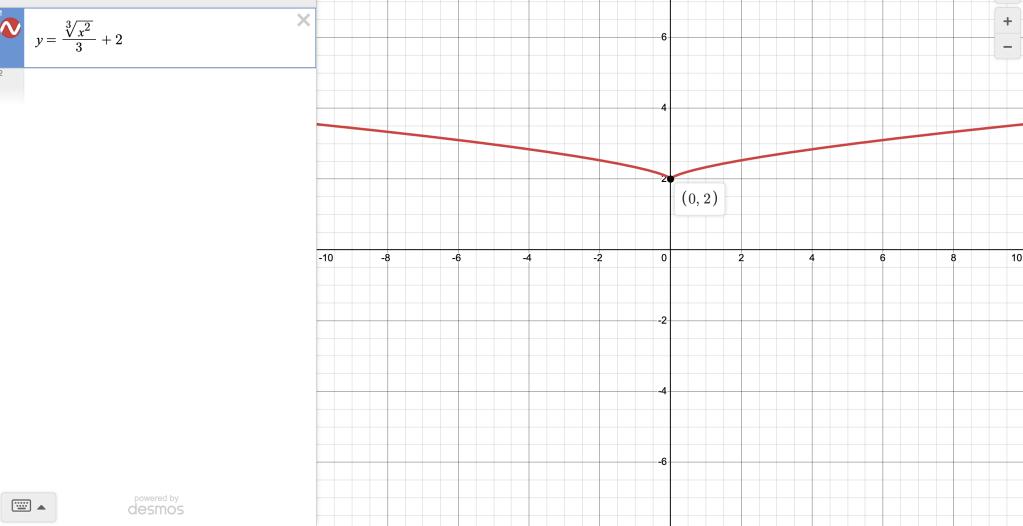
Yay! The function hits the y=axis two units up!
I think it’s time for you to do some practice. Let’s go!
- What is the y-intercept of the equation y=-5x+9?
Make sure that you jot down the answer on a piece of paper, or clearly state it in your head.
Display answer
9 is correct because it is the only term by itself, not using multiplication or division to be attached to the rest of the equation with x and y.
2. What about the equation y=6?
Display answer
In this one, it’s kind of like a trick question! The only number even there is 6, so 6 is correct.
3. What about the equation y=-93x?
Display answer
There is no number not attached to a variable, so 0 is correct.
4. What about y= x^3+4-sqrt(9x^7)?
Display answer
It’s 4. Sometimes it’s hidden within the function
5. Last one: y=[(x+3)^2]+5
Display answer
The correct answer is 14 because 3^2 makes a lone 9, added to the 5 at the end.
If you want more practice problems like these, check out this test:
If you’re still interested in intercepts, check out my article about the x-intercept.


Leave a Reply