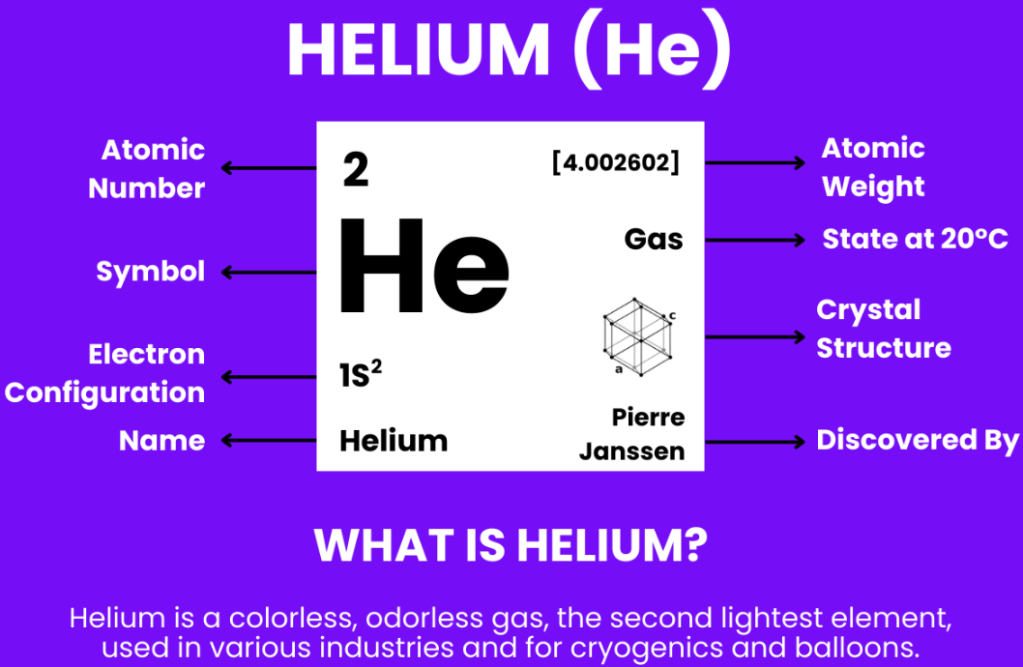
Helium is the second element of the periodic table, and it’s properties are only very similar to the two elements directly below it. Similarly to hydrogen, it’s in the general group of nonmetals, but in the specific category of noble gases, which do not react with anything. (Except for the two or three even below the two below helium that react with just a few things like fluorine sometimes.)
Helium has an atomic mass of 4.003, atomic number of 2, and it has 2 stable isotopes, He-3 and He-4. He-4 is the normal hydrogen isotope, also called protium, that is the main type of helium used in standard applications (including balloons). He-3 is a rare helium isotope, that is missing a neutron compared to He-4. Neither appear in any molecules. Helium makes up about the remaining one quarter of the universe by mass, and around eight percent by sheer number of atoms. In the atmosphere though, helium similarly makes up a tiny portion. It’s a good bit more common in the atmosphere than hydrogen: it’s at 6th place.
Helium is never in any molecules because it’s very first shell — it’s only shell — is perfectly filled with two electrons. Forcing it to make any kind of bond would take unfathomable amounts of energy, and once that energy dissipated, the bond would break, restoring the helium to its normal state and releasing a similarly explosive amount of energy. It’s not even a diatomic element, since that would require it to make a bond. It’s a lone element, in zero molecules, all by itself. Its chemical formula is simply “He”. Helium’s full electron shell is 1s2. Even though it’s way at the other side of the periodic table, seemingly with the noble gases in the p-block, it’s technically in the s-block because the electron-shell periodic table has helium right next to hydrogen. (I know, weird.)
| Isotope info | He-2 | He-3 | He-4 | He-5 |
| Abundance: | 0% | 0.000137% | 99.999866% | 0% |
| Half-life: | Undiscovered | Stable | Stable | 7.6*10^-22 s |
| Isotope info | He-6 | He-7 | He-8 | He-9 |
| Abundance: | 0% | 0% | 0% | 0% |
| Half-life: | 806.7 ms | 2.51*10^-21 s | 119 ms | 7*10^-21 s |
Images that can help you out (with what? That’s for you to decide):
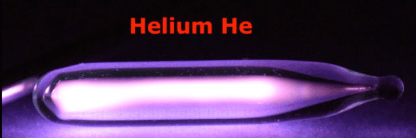
Helium sample lit up with a tesla coil.
I also have a sample of helium, just like with hydrogen, but the gas in the ampoule looks practically identical, so if you really want to see a glass bottle with a plastic cap and a small glass ampoule with visibly nothing inside, sure, go check that out.
And a video,
My favorite YouTube chemistry creator NileRed didn’t have any, and I didn’t either, so I guess random creator it is:


Leave a Reply